
Selecting a suitable proper guitar size for your child stands as a most crucial decision in a young musician’s musical journey. An wrong instrument size can hinder progress, cause physical strain, or diminish enthusiasm. This comprehensive guide helps parents navigate guitar sizing with confidence, ensuring young musicians start with instruments that match their physical dimensions and musical aspirations.

How to Choose the Perfect Size Guitar for your Child (Avoid Beginner Mistakes)
Parents often make a critical error of purchasing guitars based solely on age recommendations rather than physical measurements. This approach frequently results in oversized instruments that frustrate young learners. While many parents wonder about the best age to start guitar lessons, a key lies in understanding your child’s specific measurements along with how they relate to guitar dimensions rather than just their birth year.
Why Guitar Size Matters: Problems of Oversized & Undersized Instruments
An oversized guitar forces children into uncomfortable positions that strain muscles or compromise technique. When young hands struggle to reach around an oversized neck, fingers cannot form chords properly. A child’s arm extends beyond its natural range, creating tension in shoulders, wrists, and hands. This physical stress transforms learning into an exhausting activity rather than an enjoyable experience.
Undersized instruments present different challenges. While easier to hold, guitars that are too small limit a child’s growth potential plus may produce insufficient volume. These frets become cramped, restricting finger development as well as technique advancement.
A Key Measurement: Scale Length vs. Overall Guitar Length
Scale length represents its distance from a guitar’s nut to its bridge saddle – essentially this vibrating length of the strings. This measurement determines fret spacing and influences playability more than overall guitar length. A guitar with a 480mm (18.9-inch) scale length provides significantly different fret spacing compared to one with a 650mm (25.6-inch) scale.
Overall guitar length affects how an instrument sits against a child’s body but doesn’t directly impact finger placement or chord formation. Focus primarily on scale length when evaluating size appropriateness.

Quick Reference: Ultimate Kids’ Guitar Size Chart (Age & Height)
Fractional Guitar Sizes Explained (1/4, 1/2, 3/4, Full-Size)
Fractional sizing in guitars differs significantly from violin sizing. Guitar manufacturers lack standardisation across fractional sizes, meaning a 1/2 size from one brand may differ substantially from another manufacturer’s 1/2 size guitar. These fractions represent approximate proportions rather than precise mathematical reductions.
- 1/4 Size Guitars
- Scale length: 480-510mm (18.9-20.1 inches)
- Overall length: 760-810mm (30-32 inches)
- Body depth: 70-80mm (2.8-3.1 inches)
- 1/2 Size Guitars
- Scale length: 530-580mm (20.9-22.8 inches)
- Overall length: 860-910mm (34-36 inches)
- Body depth: 80-90mm (3.1-3.5 inches)
- 3/4 Size Guitars
- Scale length: 590-630mm (23.2-24.8 inches)
- Overall length: 910-960mm (36-38 inches)
- Body depth: 90-100mm (3.5-3.9 inches)
- Full-Size Guitars
- Scale length: 630-650mm (24.8-25.6 inches)
- Overall length: 1000-1050mm (39-41 inches)
- Body depth: 100-110mm (3.9-4.3 inches)
Average Height and Recommended Guitar Sizes for Children
| Child’s Height | Age Range | Recommended Size | Belly Button Height | Scale Length |
|---|---|---|---|---|
| 80-115cm (31-45 inches) | 4-6 years | 1/4 Size | 50-70cm | 480-510mm |
| 110-140cm (43-55 inches) | 5-8 years | 1/2 Size | 65-85cm | 530-580mm |
| 130-150cm (51-59 inches) | 7-11 years | 3/4 Size | 80-95cm | 590-630mm |
| 150cm+ (59+ inches) | 11+ years | Full Size | 95cm+ | 630-650mm |
A belly button measurement provides a most accurate sizing indicator. Measure from a floor to your child’s navel while standing. This height should approximate a top of the guitar body when an instrument rests on a child’s leg in playing position.

Determining a Right Guitar Type for a Young Beginner
A choice between classical, acoustic, paired with electric guitars significantly impacts a child’s learning experience. Understanding the differences in nylon vs steel string for beginners is vital, as each type offers distinct advantages for young players.
Classical (Nylon-Stringed) Guitars: Why They Are the Recommended Start
Classical guitars with nylon strings provide a gentlest introduction to guitar playing. Nylon strings require less finger pressure than steel strings, reducing pain and callus formation during this initial learning phase. A wider neck spacing allows small fingers more room between strings, reducing accidental string contact.
Its lower string tension creates a more forgiving touch response, enabling children to produce clear notes with minimal effort. Classical guitars typically feature a flat fingerboard radius, which suits fingerstyle playing and classical technique development.
Acoustic (Steel-Stringed) Guitars: When to Consider Them
Steel-string acoustic guitars offer brighter tone and greater volume projection compared to classical guitars. Consider steel strings when your child shows preference for folk, country, or contemporary pop music styles. This narrower neck width suits children transitioning from smaller instruments who have developed sufficient finger strength.
Steel strings demand more finger pressure and may cause initial discomfort. However, children aged 8 and older with regular practice typically adapt quickly to steel string tension.
Electric Guitars: A Kid-Friendly Option and Playability Benefits
Electric guitars often provide a most comfortable playing experience for children. Its lower string action (distance between strings and fretboard) requires minimal finger pressure. A narrower neck profile accommodates small hands more effectively than acoustic instruments.
Volume control through amplifiers allows practice at comfortable levels without straining to project sound. Electric guitars can inspire children drawn to rock, pop, and contemporary music styles.

PrivateGuitarLessons’ Recommended Guitars for Each Size
Top Picks for Small Beginners (1/4 & 1/2 Size Guitars)
1/4 Size Recommendations:
- Yamaha CGS102A: Features solid cedar top with reliable tuning stability. Scale length of 480mm suits the smallest players. Price range: $90-120.
- Cordoba C1M: Offers excellent build quality with mahogany back and sides. Nylon strings provide comfortable playability. Price range: $110-140.
1/2 Size Recommendations:
- Yamaha CGS103A: Step-up model with improved tonal qualities and consistent intonation. Scale length of 530mm. Price range: $120-160.
- Ortega R121SN: Spanish-made instrument with traditional construction methods. Superior sound projection for its size. Price range: $150-200.
Recommendations for Growing Musicians (3/4 Size Guitars)
3/4 Size Excellence:
When moving up to this size, quality becomes even more important. If you are searching for the best acoustic guitar under 300, these models offer exceptional value:
- Yamaha FG830: Steel-string acoustic with solid Sitka spruce top. Scale length of 600mm bridges the gap to full-size instruments. Price range: $200-250.
- Taylor GS Mini: Premium option with exceptional playability and tone. Slightly larger than traditional 3/4 size but manageable for most children 8+. Price range: $450-550.
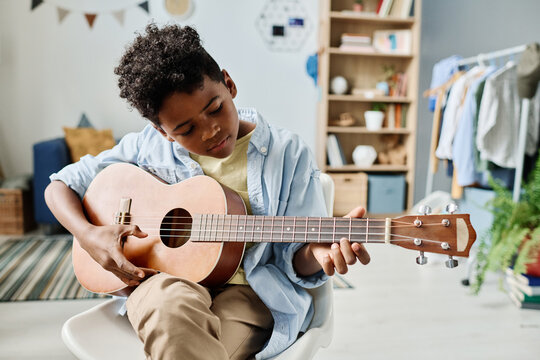
Full-Size Guitars for Older Kids (12+ Years Old)
Full-Size Recommendations:
- Yamaha FG800: Solid spruce top acoustic with excellent value proposition. Standard 650mm scale length. Price range: $200-280.
- Fender CD-60S: Mahogany back and sides with comfortable neck profile. Ideal for diverse musical styles. Price range: $180-230.
Each recommendation balances quality, playability, and value. Finding the best beginner acoustic guitar nyc shops have to offer can be overwhelming, but PrivateGuitarLessons instructors have extensive experience with these models and can provide specific guidance based on your child’s musical interests.
Beyond the Guitar: Essential Accessories for Young Guitarists
- Tuner: Digital clip-on tuners ensure consistent pitch accuracy. Models like a Snark SN5X provide clear visual displays that children can easily read.
- Guitar Picks: Light gauge picks (0.46-0.60mm thickness) work best for young fingers. Medium picks may prove too stiff for developing technique.
- Guitar Strap: Adjustable strap allows comfortable standing play and reduces instrument weight on a child’s lap during practice.
- Music Stand: Proper music stand encourages good posture and keeps sheet music at eye level.
- Guitar Case: Protection during transport and storage. Consider lightweight cases for smaller children who transport instruments frequently.
- Footstool: Classical footstool raises your left leg, positioning the guitar neck at an optimal angle for young players.

Elevate Your Child’s Learning: PrivateGuitarLessons’ Approach in New York City
The Benefits of Private Guitar Lessons for Kids
Private instruction provides personalised attention that group classes cannot match. Instructors adapt teaching methods to each child’s learning style, pace, and musical interests. This individualised approach accelerates progress while maintaining engagement and enthusiasm.
Research from this University of Kansas demonstrates that children receiving one-on-one music instruction show 23% faster skill acquisition compared to group settings. Private lessons also allow immediate correction of technique errors before they become ingrained habits.
A flexibility of private instruction accommodates busy family schedules. Lessons can focus specifically on areas where your child needs a most support, whether that’s chord transitions, reading music, or developing rhythm skills.
Finding Expert Instruction: PrivateGuitarLessons, chuyên private guitar lessons tại New York City
PrivateGuitarLessons brings professional instruction directly to your home throughout New York City’s five boroughs. For parents seeking private acoustic guitar lessons nyc, our vetted instructors hold music degrees and possess extensive experience teaching children aged 4 through adult.
Service Areas Include:
- Manhattan: Upper East Side, Upper West Side, Midtown, Lower East Side
- Brooklyn: Park Slope, Williamsburg, DUMBO, Bay Ridge
- Queens: Astoria, Long Island City, Forest Hills
- Bronx: Riverdale, Pelham Bay
- Staten Island: St. George, Tottenville
Why Choose In-Home Lessons:
- Eliminates travel time and transportation challenges
- Creates comfortable learning environment in familiar surroundings
- Allows parents to observe progress and practice techniques
- Accommodates multiple children in one family efficiently
Instructor Qualifications:
- Background-checked professional musicians
- Minimum 5 years teaching experience
- Specialisation in age-appropriate teaching methods
- Fluency in multiple musical styles and genres, offering everything from kids’ beginners classes to private guitar lessons for seniors.
A convenience of in-home instruction combined with expert teaching creates optimal conditions for your child’s musical development. Contact PrivateGuitarLessons today to schedule your child’s first lesson and begin their musical journey with a right-sized instrument and professional guidance.
Contact Information:
- Website: www.privateguitarlessons.com
- Phone: (212) 247-4900
- Service Hours: Monday-Sunday, 9 AM-9 PM
- Initial consultation includes instrument sizing assessment
Frequently Asked Questions (FAQ)
What is the most important factor when sizing a guitar for a child?
The most important factor is the scale length of the guitar, which is the distance from the nut to the bridge saddle. This measurement dictates the fret spacing, directly influencing how easily a child’s fingers can reach and form chords. A common mistake is relying only on a child’s age or a guitar’s overall length, which are less accurate indicators of playability.
Should a beginner child start with a classical (nylon) or acoustic (steel-string) guitar?
A beginner child is highly recommended to start with a classical, nylon-stringed guitar. Nylon strings are gentler on young fingers, requiring less pressure to press down, which reduces initial discomfort and callus formation. Furthermore, classical guitars typically have a wider neck, which provides more space for small hands to maneuver between strings.
How can parents ensure their child maintains enthusiasm for guitar lessons?
To ensure sustained enthusiasm, parents should start with the correct sized instrument and seek expert, personalized instruction. The right size prevents frustration and physical strain, while private lessons from a qualified instructor (like those at PrivateGuitarLessons) provide tailored teaching methods that match the child’s pace, learning style, and musical interests, accelerating progress and maintaining engagement.
