
Starting guitar lessons transforms children’s musical journey in remarkable ways. Parents across New York City frequently ask when their youngsters should begin formal instruction. The answer involves multiple factors beyond simple chronological age.
The benefits of music education include lifelong improvements in children’s cognitive development, emotional expression, as well as social skills. Guitar lessons specifically enhance fine motor coordination, mathematical understanding through rhythm or counting, plus confidence through performance achievement.
 What is the Ideal Age to Begin Guitar Lessons for a Child?
The Short Answer: Age 6-8 is Often Optimal
Most children develop the necessary physical or cognitive skills for guitar instruction between ages 6 to 8. During this developmental window, students typically possess sufficient finger strength, attention span, plus receptiveness to structured learning.
Research demonstrates that children aged 6-8 show enhanced neuroplasticity, making musical skill acquisition more efficient. Their hand size accommodates smaller guitars (1/2 or 3/4 size), while their cognitive development supports following multi-step instructions, and understanding cause-to-effect relationships in music.
The 6-8 age range allows children to grasp fundamental concepts like note recognition, rhythm patterns, or basic chord formations. This foundation becomes crucial for advanced techniques later in their musical development.
Why Readiness along with Interest are More Important Than Chronological Age
Individual readiness surpasses chronological age in determining lesson success. Some 5-year-olds demonstrate exceptional focus plus coordination, while certain 9-year-olds may lack the patience required for consistent practice.
Observing your child’s natural musical inclinations provides valuable insights. Children who sing along to songs, move rhythmically to music, or show curiosity about instruments often display internal readiness regardless of age.
Physical development varies significantly among children. Hand size, finger dexterity, as well as core strength for proper posture develop at different rates. These factors directly impact a child’s ability to form chords, strum accurately, plus maintain comfortable playing positions during 30-45 minute lessons.
5 Key Signs Your Child is Truly Ready for Private Guitar Lessons
Physical Dexterity as well as Hand Size for Fretwork
Successful guitar playing requires specific physical capabilities that develop gradually. Your child should demonstrate the ability to press individual fingertips onto guitar strings without accidentally muting adjacent strings.
Hand span measurement provides a practical readiness indicator. Children need approximately 6.35 centimetres (2.5 inches) of comfortable finger spread to navigate basic chord shapes on appropriately sized instruments.
Fine motor skills assessment reveals readiness through activities like buttoning clothes independently, using scissors with precision, or manipulating small building blocks. These skills directly translate to fret navigation, while also helping with string manipulation during guitar performance.
The Ability to Concentrate, plus Follow Instructions
Guitar lessons demand sustained attention for 15-30 minute intervals initially, progressing to 45-60 minutes for intermediate students. Children should demonstrate focus during story time, puzzle completion, or similar structured activities before beginning formal instruction.
Following sequential instructions becomes essential for learning proper technique. Students must remember finger placement, strumming patterns, and posture corrections simultaneously. This cognitive juggling develops progressively through elementary school years.
Patience during repetitive activities signals readiness for the practice required in guitar mastery. Children who persist through challenging tasks show the temperament necessary for overcoming technical obstacles inherent in musical instrument learning.
Genuine and Sustained Interest in Music
Authentic musical interest manifests through spontaneous singing, dancing, or rhythmic movement. Children who request specific songs repeatedly or attempt to “play” makeshift instruments demonstrate intrinsic motivation crucial for long-term success.
Sustained interest differs from fleeting curiosity. Genuine enthusiasm persists through multiple weeks or months, surviving initial excitement phases. This endurance predicts commitment to regular practice schedules and lesson attendance.
Environmental exposure to diverse musical genres helps identify authentic interest patterns. Children who engage with classical, pop, folk, and contemporary music show broader musical appreciation that supports comprehensive guitar education.

Patience and Managing Frustration
Learning guitar involves numerous challenges that test emotional regulation. Children must develop coping strategies for finger soreness, coordination difficulties, and initial sound quality concerns.
Frustration tolerance appears during activities requiring persistence, such as learning to ride a bicycle, completing jigsaw puzzles, or mastering new games. These experiences parallel the emotional demands of guitar skill development.
Positive responses to constructive criticism indicate emotional readiness for instruction. Guitar teachers provide frequent feedback regarding technique, timing, and musical interpretation. Students need resilience to incorporate suggestions without discouragement.
Basic Understanding of the Alphabet and Numbers
Guitar instruction incorporates alphabet recognition for chord names (A, B, C, D, E, F, G) and number comprehension for fret positions, finger numbering, and counting beats.
Reading readiness supports music notation introduction, even for students focusing primarily on chord-based playing. Basic literacy skills enhance lesson efficiency and home practice effectiveness.
Mathematical concepts appear throughout guitar learning. Time signatures, note values, and rhythm counting require numerical understanding that typically develops during kindergarten and first-grade years.

What to Expect from Guitar Lessons at Different Ages
Toddler Lessons (Ages 3-5): Focus on Fun, Rhythm, and Motor Skills
Early childhood guitar exposure emphasises musical exploration rather than formal technique development. Toddler programmes typically incorporate singing, movement, and rhythm instruments alongside guitar introduction.
Lessons for this age group last 15-20 minutes maximum, matching natural attention spans. Activities include strumming simple patterns, identifying guitar parts (body, neck, strings), and developing steady beat recognition through songs and games.
Motor skill development takes priority over musical complexity. Children practice proper sitting posture, gentle string touching, and basic strumming motions using appropriately sized instruments (1/4 or 1/2 size guitars weighing 0.45-0.9 kilograms).
Early Elementary (Ages 6-8): Introduction to Formal Technique and Reading Music
Formal guitar instruction begins during early elementary years with structured lesson formats and technical skill development. Students learn proper finger placement, basic chord formations, and fundamental strumming patterns.
Music reading introduction occurs gradually, starting with rhythm notation and progressing to simple melodies. Children typically master 3-5 basic chords (G, C, D, Em, Am) during their first year, enabling performance of numerous popular songs.
Practice expectations increase to 15-20 minutes daily, developing discipline and routine essential for musical progress. Parents play crucial supportive roles in establishing practice schedules and encouraging consistent effort.
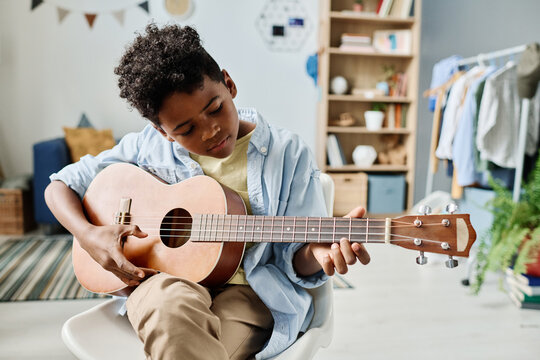
Pre-Teens (Ages 9-12): Potential for Rapid Progress and Theory Introduction
Pre-teenage years often showcase accelerated learning due to improved coordination, extended attention spans, and enhanced cognitive processing. Students frequently master complex chord progressions, fingerpicking techniques, and intermediate music theory concepts.
This age group demonstrates increased independence in practice sessions and lesson preparation. Many students begin exploring personal musical preferences, requesting specific songs, and even showing interest in an electric guitar for kids age 10 or older to match their evolving tastes.
Music theory introduction becomes more comprehensive, including scale patterns, key signatures, and harmonic relationships. These concepts support improvisation skills and musical composition attempts common during pre-adolescent creative development.
Starting Guitar in the Teenage Years: High Motivation and Personal Goal Setting
Teenage guitar students often display exceptional motivation driven by personal musical goals, peer influence, and identity formation through artistic expression. Many begin lessons with specific repertoire targets or performance aspirations.
Cognitive maturity enables rapid technical progress and sophisticated musical understanding. Teenagers grasp complex concepts like chord substitutions, advanced rhythms, and stylistic techniques across genres from classical to contemporary rock.
Social aspects of guitar playing become prominent during teenage years. Many students join bands, participate in school music programmes, or pursue performance opportunities that enhance motivation and skill development.

Essential Tips for Parents Starting a Child on Guitar
Choosing the Right Size Instrument for Beginners
Proper instrument sizing ensures comfortable playing position and prevents physical strain during practice sessions. Children aged 4-6 typically require 1/4 size guitars (48 centimetres scale length), while 7-9 year olds suit 1/2 size instruments (53 centimetres scale length).
Full-size guitars (65 centimetres scale length) become appropriate for children over 150 centimetres tall, usually occurring around age 10-12. Incorrect sizing leads to poor posture, technique problems, and potential repetitive strain injuries.
Quality starter instruments balance affordability with playability. Avoid extremely cheap guitars that produce poor sound quality and require excessive finger pressure, discouraging student progress. Budget ranges of $150-400 typically provide adequate beginner instruments.
Setting Fair and Realistic Practice Expectations
Consistent practice schedules prove more effective than lengthy, irregular sessions. Young children benefit from 10-15 minute daily practice periods, gradually increasing to 20-30 minutes as skills and attention spans develop.
Quality supersedes quantity in practice effectiveness. Focused practice addressing specific techniques or songs produces better results than unfocused, extended sessions. Parents should encourage mindful practice rather than simply watching the clock.
Celebrating small achievements maintains motivation during challenging learning periods. Progress markers include mastering new chords, playing favourite songs, or improving rhythm accuracy. Regular acknowledgment of these milestones sustains long-term commitment.
The Importance of Finding a Supportive Guitar Teacher
Teacher selection significantly impacts student success and long-term musical enjoyment. Effective instructors combine technical expertise with age-appropriate communication skills and patience for individual learning paces.
Teaching philosophy alignment matters tremendously. You may want to discuss the suzuki guitar method vs traditional approaches with potential teachers to see which methodology best suits your child’s learning style.
Trial lessons provide valuable assessment opportunities for teacher-student compatibility. During these sessions, observe communication styles, lesson structure, and your child’s comfort level with the instructor’s approach.
Why PrivateGuitarLessons Excels at chuyên private guitar lessons tại New York City
Our Proven Curriculum for Young Learners in NYC
PrivateGuitarLessons has developed comprehensive curriculum specifically designed for New York City’s diverse student population. Our methodology incorporates age-appropriate techniques, cultural musical preferences, and flexible pacing that accommodates busy urban family schedules.
Our structured approach begins with fundamental skills including proper posture, basic chord formations, and rhythm development. Whether focusing on pop hits or specialized private classical guitar lessons nyc parents appreciate our ability to build strong technical foundations.
We integrate popular contemporary songs alongside traditional teaching materials, maintaining student engagement through familiar repertoire. This approach helps children connect their guitar skills with music they hear in daily life throughout New York City’s vibrant musical landscape.
Personalized Instruction for Every Child’s Pace
Individual attention allows our instructors to adapt teaching methods for each student’s learning style, whether visual, auditory, or kinaesthetic. This personalisation proves especially valuable for children with different cognitive processing patterns or attention capabilities.
Our teachers assess student strengths and challenges during initial lessons, creating customised practice materials and technique exercises. This targeted approach accelerates progress while preventing frustration from inappropriately difficult material.
Regular progress evaluations ensure students advance at optimal paces without rushing through important foundational concepts. We adjust lesson content based on individual development, ensuring solid skill building rather than superficial coverage.
How to Schedule a Trial Lesson with Our New York City Instructors
PrivateGuitarLessons offers convenient trial lesson scheduling through our online booking system, accommodating busy NYC family schedules including evenings and weekends. Simply visit privateguitarlessons to check availability and book an introductory session.
During trial lessons, students and parents meet potential instructors, explore our curriculum materials, and discuss individual goals and expectations. This consultation process ensures optimal teacher-student matching before committing to regular instruction.
Our Manhattan, Brooklyn, and Queens locations provide accessible options for families throughout New York City. We also offer in-home instruction for added convenience, bringing professional guitar education directly to students’ familiar practice environments.
Frequently Asked Questions About Starting Guitar Lessons
Is It Ever Too Late to Start Learning Guitar?
Absolutely not. Guitar learning opportunities exist throughout life, with each age bringing unique advantages to the musical journey. Adult beginners often demonstrate exceptional focus, clear goal-setting abilities, and consistent practice habits that accelerate skill development. In fact, learning guitar at 40 or beyond can be incredibly rewarding. Neuroplasticity research confirms that musical skill acquisition benefits brain health at any age, enhancing cognitive function, emotional regulation, and social connection opportunities regardless of when instruction begins. Many successful guitarists began their musical journeys during adolescence or adulthood, proving that a late start does not limit achievement potential; personal enjoyment and creative expression provide valuable rewards independent of professional aspirations or virtuosic skill levels.
Image suggestion: A warm, encouraging photo showing children of various ages (6-12) holding appropriately sized guitars with big smiles, set in a bright, welcoming music lesson environment with a qualified instructor nearby.
